



































































East London is England's unhappiest place to live, says unscientific promotional survey
A completely unscientific promotional survey has revealed that moustaches, pop-up bone marrow restaurants and copious amounts of drugs do not, in the end, make people happy.
The Dorset Echo, which reports from a happy place, explains:
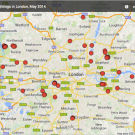
The questionnaire, put together by property firm Rightmove, looked at things like size, value and decor of homes, safety, friendliness of neighbours and the quality of local amenities.
The survey, like this one we covered last year, proves once and for all that people should just get out of this godforsaken hellhole before it’s too late.
Bottom 10
1. London: East
2. Ilford
3. London: Southeast
4. Luton
5. Romford
6. Oldham
7. Enfield
8. London: North
9. London: West
10. Harrow
Dorset Echo – Dorchester named as one of the happiest towns in country
Snipe – Survey reveals Londoners to be more unhappy than rest of UK. You miserable gits
10 Feb 2012
Singing about sleeping rough around Victoria Station
The charity for homeless persons, Broadway, contributed to this music video supposedly inspired by an unknown homeless man who was overheard one day singing the opening hook.
09 Feb 2012
Reviewed: Looking in Wonderland at Finchley artsdepot - remarkable illustrations of remarkable books

“The night is fine,” the Walrus said.
“Do you admire the view?”
These might well be the most magnificent lines in all of English poetry.
Having lured the young oysters across the beach, away from the safety of the lapping waves, Lewis Carroll’s Walrus intimates to them that it is time for food. Too late, they realise their mistake. The food is them. They are to die. They can only beg for a mercy they know will never come. In response, the Walrus does something extraordinary. He turns away from their sobbing prayers, looks out at the timeless sky and the boundless sea, and admires the view.
Is it not magnificent? Confronted with imminent oysterial death, his gaze turns to the eternal. Little oysters, he says, do not mourn yourselves. What are you compared with the sea, the air, the endless stretch of time which follows and precedes you? You are nothing. Now then, let’s have some tea.
This moment is now on display in an exhibition of Sir John Tenniel’s illustrations at the artsdepot, Finchley.
The exhibition is slight. It consists of prints from the two Alice books, taken from woodcuts based on Tenniel’s original illustrations. When I visited, a couple of labels lay scattered on the floor, their blu tack having failed. A carved woodblock hid behind some glass, almost out of view and impossible to study closely. There was some context on the walls, but only a handful of insights. The illustrations were left to speak for themselves.
But what illustrations they are.
There’s the Jabberwock, a monster in a waistcoat, which was deemed too scary for the frontispiece of the book.

There are slithy toves, gyring and gimbling in the wabe. Carroll invented the words, Tenniel invented the image to go with them. This is creativity squared.

There are March Hares and Cheshire Cats, the Queen of Hearts and a flightless, fat, ridiculous Dodo.

A Dodo which squats, extinct, between fiction and reality. The Dodo does not exist, just as the Jabberwock does not exist. What difference, Carroll asks, is there between them, now?
The illustrations are much finer on paper than in these grainy JPEGs taken from Wikipedia. Does that justify a trip to Finchley to see them, when they are all available just a click away? On balance, I’d say not unless you’re passing. The image quality aside, there’s little from this exhibition that you couldn’t get online or in an ebook. The magnificent Walrus is now public domain. He was right not to mourn the oysters. They live on forever, online.
Looking in Wonderland at the artsdepot, Finchley
Sir John Tenniel’s illustrations on Wikpedia
The Walrus and the Carpenter, by Lewis Carroll
09 Feb 2012
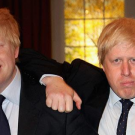
Boris Bye-law suggests a new repressive Parliament Square
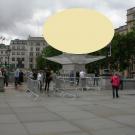
Last week it emerged that Boris Johnson has been busily redrafting the bye-laws governing permitted activities in Parliament and Trafalgar Squares.
The Mayor was responding with almost palpable glee to the clearing of the Parliament Square protest camp, several months after the death of its figurehead Brian Haw. The new bye-laws are predictably repressive, effectively banning press photography and, presumably accidentally, seeming to outlaw mobile phones.
But the Boris Bye-laws are simply building on restrictions imposed by Saviour of the London Left Ken Livingstone, back in 2002. Red Ken signed the last set of bye-laws, which banned written or pictorial notices, public speeches, the playing of musical instruments, and any “assembly, display, performance, representation, parade, procession, review or theatrical event” without prior permission. The bye-laws predate by three years the Serious Organised Crime and Policing Act, which restricted protest within a kilometre of Parliament.
It is no surprise that a Conservative mayor has quickened the pace of repression in the capital. But it is important to understand that this habit of restriction is not unique to the Tories, but is instead part of the pattern of development of the neoliberal city.
London is perhaps the archetypical neoliberal city. Its characteristics both mirror and cause the social relations that we experience under neoliberalism. Above all, London demonstrates neoliberalism’s appetite to privatise space – to take what was public, and to compensate us with space that appears public but in which our freedom to act is restricted or removed.
We might understand this as a new phase in the centuries-old story of enclosure. For 800 years landowners, and subsequently Parliament, have ‘enclosed’ common land, restricting or preventing public access and instead using it to generate private profit. In the 15th and 16th Centuries, land that had previously been used to grow crops was enclosed by the rich, who then used it for pasture – because it was more profitable to sell wool than it was to grow food. No matter, of course, that this theft of land destroyed settlements and left the country at risk of famine.
Today the enclosures tend to be less dramatic, more insidious. The neoliberal city is characterised by space that is ostensibly open, but in which public activity is dramatically curtailed – and, consequently, in which corporate pseudo-police have become a fixture. Consider the prevalence of private security in the City of London’s endless covered squares, processing around the concrete and glass in high visibility jackets. Try assembling or conversing with more than a couple of people in one of those areas and see how they react.
Parliament and Trafalgar Squares are no longer public spaces. Their function is to provide the appearance of a functioning city, of a society in which people are allowed to freely associate. The neoliberal state is incapable of permitting true public space – but it is required to provide space that appears public. This phenomenon will become increasingly prevalent during the Olympics. Space will be produced in which the public spectacle can occur – but in which actions outside the choreography will not be permitted. Indeed, as new powers to seize political materials from homes demonstrate, the state intends to regulate behaviour in every possible part of the city.
There is very little truly public space left in the UK. One of the most significant achievements of the Occupy movement has been the reappropriation of space in the heart of the city. Of course, there are innumerable problems with their decisions regarding what to do with that space – but it is difficult to argue that St Paul’s is not now more public than it was before October.
As the Olympics approaches, and as resistance to austerity begins to grow, securing public space will become imperative. The government knows this; that is why they are criminalising squatting. We should all think about ways to resist this criminalisation – but we must also think harder about reappropriating public space. Occupy has set the scene; we should consider how we use this as a starting point to retake the city.
09 Feb 2012
London agenda for Thursday 9 February
1. View a photographer’s take on the Last Days of Mubarak [Le Cool]
2. Climb up to the Book Club and join the Sing-a-long Fiddler on the Roof
3. Chat with John Lahr, the author of “Prick Up Your Ears”, the biography of Joe Orton and the senior drama critic of the New Yorker [Don’t Panic]
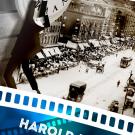
4. Watch the 1923 version of Salomé with Charlie Barber’s music live at the Southbank Centre [Ian Visits]
5. See the James Henry Greathead statue [Tired of London]
09 Feb 2012
awE naturalE by THEESatisfaction
awE naturalE, the debut album from Seattle duo and Shabazz Palaces collaborators THEESatisfaction, is due for release March 27th via Sub Pop. Catch them at White Heat, April 24th. Today’s MPFree is a silky smooth groove from said album, available here in exchange for an e-mail address.
08 Feb 2012
Clapton Orient - when footballers were proper heroes
Here’s a video of Clapton Orient, the ancestors of Leyton Orient, playing the last match of the 1914/15 season.
At the end of the game (Clapton Orient 2-0 Leicester Fosse) there was a farewell parade, because 41 players and staff were heading off to join the Footballers Battalion. Three players died at the Somme.
Source: BFI YouTube channel
08 Feb 2012
LibDem mayoral candidate might not care about trains, but at least he's got policing down
On Monday Brian Paddick said something silly about trains not really being that important.
Well, today it’s crime day in the Mayoral election campaign, and he’s on much safer ground. We’ve already had Ken Livingstone’s crimey new video and now Paddick has a piece up at the Guardian.
Paddick’s is much the better contribution, since it attempts an analysis of policing which goes beyond the “more police good, fewer police bad” rhetoric of Livingstone. Here’s the key passage:
While those on the right call for plastic bullets and water cannons and those on the left blame cuts by the coalition government, we are missing a crucial point: the authority of the police is no longer accepted by an increasingly large number of people. Unless this position is reversed, nearly two centuries of policing by consent – where the public agree to co-operate with the police and actively support them – will have to be abandoned.
It’s not just about how many police there are, it’s about how they police us. Under Bernard Hogan-Howe there’s been some welcome talk of refocussing stop and search, and some less welcome talk about tasers in every police car. This is where the debate should be. The numbers of police aren’t irrelevant, but they aren’t the only story in town.
Kudos to Paddick for raising this. He might not give a shit about the trains, but when crime and policing is at issue at least he’s in the game.
Brian Paddick at the Guardian – London is increasingly policed by force not consent – thanks to its mayors
Snipe – London’s trains don’t really matter, LibDem mayoral candidate declares
Snipe – Ken Livingstone’s crime campaign video
Snipe – The Met’s stop and search webchat digested
Snipe – Why a taser in every police car is a bad idea
08 Feb 2012
Ken Livingstone's new campaign video has a tasty pop at Mayor Johnson's holidays
Another day, another campaign video from The Big Two.
This is Ken Livingstone on crime. It’s political campaigning 101. Take some people who are victims of crime, make the viewer feel sorry for them, and implicitly blame the incumbent for their suffering.
Does it work?
Well the victims are played by actors who are about as convincing as the cast of Hollyoaks. The first minute drags, which is fatal for any YouTube video, and the talk of “savage cuts in policing” opens up a whole barrel of statistical worms (see eg this on whether police numbers are rising or falling) which turns any debate over the running of the Met into an unsightly squabble over numbers.
This line, however, is quite tasty:
“[Victims] deserve a Mayor that won’t stay on holiday when riots erupt on our streets.”
Ouch.
Basically Ken doesn’t want to be out-toughened on crime. Which means we’re going to have lots of irrelevant arguments about the exact numbers of police in the Met, and very little discussion of how those people police us.
I wonder what joys tomorrow’s YouTube will bring.
Channel 4 Factcheck – Does Boris have the right to weigh into the police cuts row
Previous campaign videos dissected:
Mayor Johnson’s £3.10 council tax cut
Ken Livingstone’s 7% fare cut
08 Feb 2012
London agenda for Wednesday 8 February
1. Die with the proper elan at the School of Life [Le Cool]
2. Visit the ‘busy intersection of leftfield but party-hardy musical styles’ of Friends at XOYO [Run Riot]
3. Chat with director Martyn Burke and producer Anthony Feinstein over their doc Under Fire: Journalists in Combat [Don’t Panic]
4. Clear the agenda for the most important event of the day: celebrating the centenary of Britain’s first public automatic telephone exchange [Ian Visits]
5. Eat at Pizza East [Tired of London]
08 Feb 2012

Snipe Highlights
Some popular articles from past years
- Silencing the Brick Lane curry touts could be fatal for the city's self-esteem
- The five best places in London to have an epiphany
- Margaret Thatcher statue rejected by public
- Only 16 commuters touch in to Emirates Air Line, figures reveal
- Hope and despair in Woolwich town centre
- Peter Bayley has worked for 50 years as a cinema projectionist in East Finchley
- A unique collection of photos of Edwardian Londoners
- Summer Camp: Roll out those lazy, hazy, crazy days
- Could red kites be London's next big nature success story?
- 9 poems about London: one for each of your moods
© 2009-2026 Snipe London.